

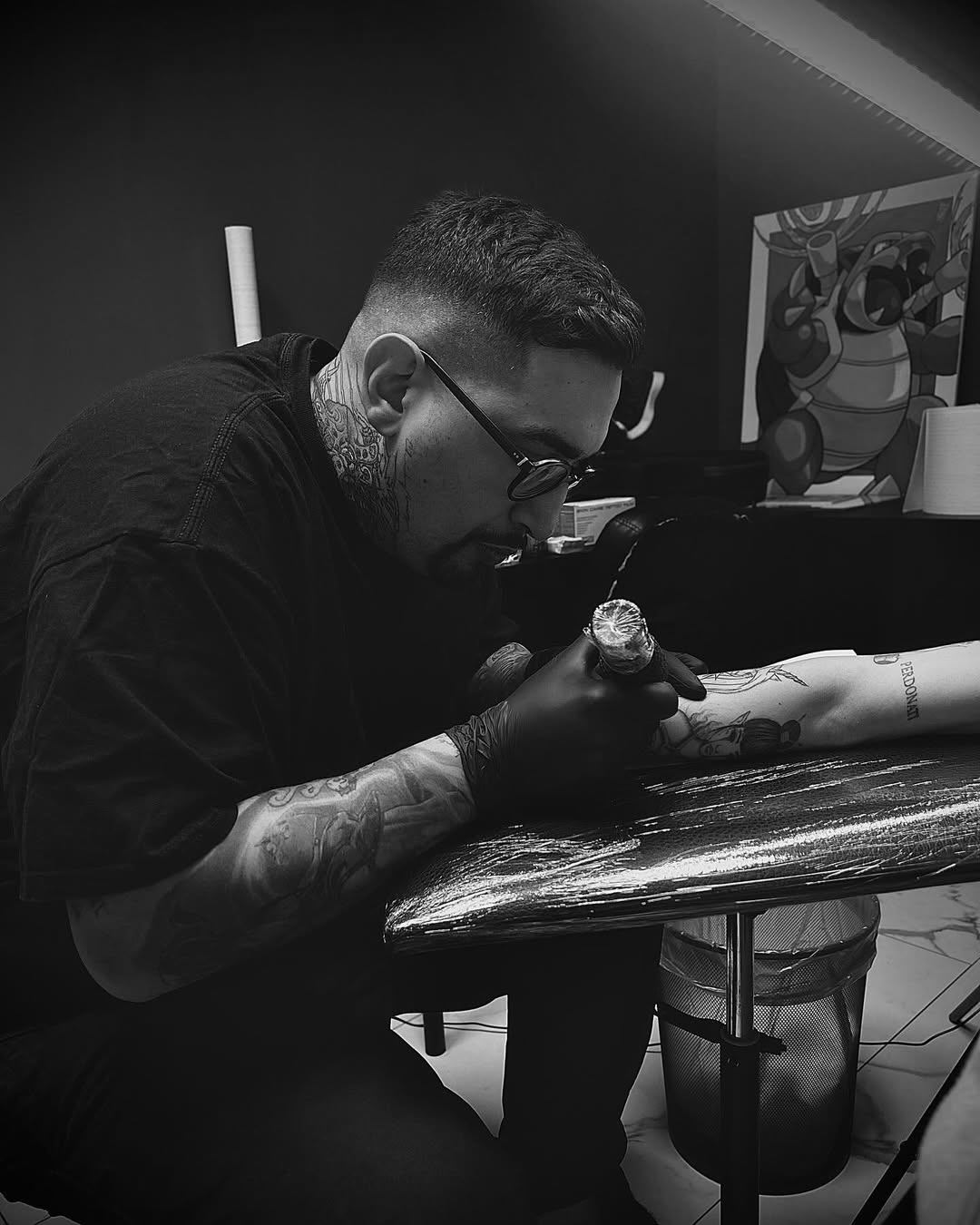
Artist
FUDO
Information
FUDO
La Convention Tattoo più cool del Nord Italia, 400 stand e oltre 60 performance live.

Tattoografia. Analisi di un tatuaggio
Written by Omar Fassio, Manuella Crini, Madame Pagu, Riccardo Filimbaia
The art of tattooing dates back to the transition from Prehistory to History and is a fundamental part of human evolution. On an individual level, every child—once they learn to hold a pen—instinctively scribbles on their own hands: it seems there is something atavistic in the desire to draw on the skin. Tattooing therefore deserves greater attention from psychology, because the claim—common until just a few decades ago—that it is merely a symptom of restlessness, discomfort, or self-harm is now an outdated and superficial interpretation.
The hypothesis put forward in Tattoografia is that tattoos relate to the body in the same way dreams relate to the mind. For this reason, the curator analyzes them by uncovering the motivations, emotions, and desires of those who “wear” them, showing how each tattoo contains a story that, in order to be told, requires something beyond words.
The autors

Omar Fassio, born in Turin in 1976, is a psychologist, psychotherapist, PhD in Clinical and Interpersonal Psychology, and a psychoanalyst (Italian Psychoanalytic Society). He has served as adjunct professor at several Italian universities and is the author of dozens of national and international scientific articles.
In the literary field, he has published novels (Eve Editore, Astro Edizioni, and Golem Edizioni), a short story collection (Ogni amore è un primo amore, 2024, Golem Edizioni), and, together with Massimo Tallone, co-authors short essays in epistolary form titled Corrispondenze (Golem Edizioni). He is also a board member of the Order of Psychologists of Piedmont.
Fassio has coordinated three editions of writing courses for professionals belonging to the Orders of Physicians, Lawyers, and Psychologists of Turin and Piedmont.

Manuella Crini, Ph.D., born in Ovada (Piedmont), is a clinical and forensic psychologist with a private practice in Alessandria. She graduated in Psychology from the University of Turin, where she also earned a PhD in Human Sciences, and completed several advanced degrees, including in specific learning disorders, psychodiagnostics, and forensic technical consultancy.
She has collaborated with the Universities of Turin and Bergamo in teaching activities and has developed projects against bullying and for women’s self-defense. Her approach integrates mind, brain, and body, with a strong scientific and relational focus.
Crini is also active online, where she shares psychological reflections and outreach content. She collaborated with Dr. Omar Fassio on the writing of Tattoografia, driven by her personal passion for tattooed skin.

Madame Pagu, born in São Paulo (Brazil), is a visual artist, writer, and researcher. Since 2015 she has lived in Italy, where she has dedicated herself to artistic production that, through photography, the appropriation of objects and images, textile art, and new media, creates works deeply immersed in the feminine universe. Her research explores the connection between human relationships, the perception of time, and identity—conceptual and aesthetic references that shape her poetic practices and experiments.
She contributed to the writing of Tattoografia, bringing her distinctive sensitivity to the team.

Riccardo Filimbaia was born in Genoa in 1981, where he still lives. He graduated from the Faculty of Law in Genoa and obtained a Master’s degree in Legal Professions in Turin in 2013. A practicing lawyer since 2015, he worked both in-house and privately between Milan, Turin, Genoa, and Ovada. In 2017, he left the legal profession to attend the Comics School in Turin. In 2019, he began his career as a tattoo artist, working between Turin and Genoa.
He contributed to Tattoografia both as a subject of the book and as the author of the tattoos featured in it.
Since September 22, 2024, the streets of Milan have become the stage for a unique initiative: “Street Philosophy,” a project created by Davide Valenti in which philosophy meets the public directly on the sidewalk. Equipped with a microphone and a chalkboard, Valenti gives lessons open to anyone willing to stop and listen. The first sessions took place in Piazza Affari, under Maurizio Cattelan’s installation, marking the beginning of a journey that combines knowledge, art, and interaction.
Davide Valenti is a high school teacher of philosophy and history, but his experience goes far beyond traditional teaching. A former advertising creative and visual artist, he has transformed philosophy into an artistic performance that decontextualizes the classroom experience to give it new meaning, evoking the spirit of the great thinkers of antiquity: like Socrates and Diogenes, who challenged the citizens of Athens with provocative and intimate questions.
Registered on the list of street artists, Valenti books his space in the city every Sunday, where he explores the ideas of philosophers throughout history, from Thales to the present day, engaging the public through questions, discussions, and workshops.
The difference between a street philosophy lesson and an online class is radical: it’s not just speaking in front of a camera. Here, the interaction is real, immediate, and unpredictable. The teacher is fully exposed, subject to the judgment and attention of the audience, with no filters or protections. It’s not a theatrical or television performance: the audience is not invited—they are there by choice, and the risk of being ignored or unappreciated is real.
It is precisely this risk that lies at the heart of the project. Each street lesson is an inner challenge, a way for Valenti to confront his own need for acceptance and to demonstrate that discussing what truly matters with strangers is not only possible but essential. Street philosophy thus emerges as an act of courage and connection: an invitation to anyone willing to go beyond themselves, discovering the value of shared thought and collective curiosity.

Joe Patty is a master of the ancient spiritual skin work from the islands of Maluku.
He is one of the last practitioners left in the world of this ancient warrior culture, and an old apprentice of the Tuhaka whanau from Ngati Porou, Aotearoa.
Next to traditional and spiritual skin work from his islands he also makes contemporary pacific fusion art/tattoos. He will not do traditional work from other parts of the pacific so as to not break any cultural and spiritual protocols from those islands out of respect.
He works with traditional hand tools called “Likata Hoha laha likata Tatu” made from native wood and also electric machines.
Gabriele Donnini, one of the most renowned tattoo artists in Rome, will present the book “Amomamma. Il carcere visto attraverso il tatuaggio”, written in collaboration with Daniela Attili e Paola Bevere.

Amomamma. Il carcere visto attraverso il tatuaggio
Written by Daniela Attili, Paola Bevere and Gabriele Donnini.
Writing on one’s own skin is a practice that dates back thousands of years. This book explores tattooing as a form of communication, self-determination, and the exercise of freedom, highlighting—through a variety of perspectives—its implications within penitentiary institutions.
Immersing itself in prison life, the text first explains why tattoos hold such a powerful symbolic value for inmates—who live in a condition of vulnerability, lacking adequate safeguards for their physical, psychological, existential, and legal security. For them, the image imprinted on the body becomes the only tangible form of expression that cannot be taken away. After outlining the legal frameworks, techniques, tools, and some health-related aspects, the book addresses the issue of clandestinity, which makes tattooing in prison particularly dangerous. The direction institutions should pursue, it argues, is that of harm reduction—both physical and existential.
Amomamma thus invites readers to reflect on a phenomenon tied to human dignity and the fundamental rights of prisoners, with the ambitious aim of fostering a more peaceful and inclusive social coexistence.
Daniela Attili lives in Ventotene and is a psychologist and psychotherapist with an existential-anthropological approach. She has served as a consultant for the Ministry of Justice.
Paola Bevere lives in Rome, where she works as a lawyer and teaches Penal Enforcement Law and Penitentiary Law at LUMSA University.
Gabriele Donnini, tattoo artist, lives in Rome and has owned the Tattooing Demon Studio since 1986.
The Razzouk Family

The Legacy of Razzouk Tattoo: A Timeless Journey
Tattooing is more than an art—it is a story passed down through centuries. At Razzouk Tattoo, this story began over 700 years ago in Egypt, where our ancestors tattooed Christian Copts with small crosses on their wrists to grant them access to churches. These tattoos, given from infancy, became a mark of faith and identity. Five centuries ago, our family brought this sacred tradition to The Holy Land, making Jerusalem the heart of religious tattooing for pilgrims from around the world.
The Founders of a Tradition
Our journey began with our ancestors, who carved intricate tattoo stencils from wood, inspired by biblical motifs such as the crucifixion, ascension, and the Madonna. These blocks became tools of devotion, used to tattoo pilgrims as tangible reminders of their faith and their sacred journey to the Holy Land.
Jacob Razzouk, known as Hagop the tattooer, revolutionized the craft. He was the first tattooist in the region to use an electric machine powered by a car battery and introduced color tattoos. His legacy includes tattooing the Emperor of Ethiopia -Haile Selassie- in the 1930s and mentoring countless artists who preserved Christian tattooing traditions.
A Living Heritage
Today, Wassim Razzouk, the 27th generation, continues this unparalleled tradition alongside his sons, Anton and Nizar. Together, they bridge the past and the present, ensuring this sacred art endures. Pilgrims from across the globe still seek tattoos at Razzouk Tattoo, bearing designs that have been passed down through generations, including the iconic Jerusalem Cross—a symbol of faith and heroism since the First Crusade.

Johnny Domus is a Portuguese artist with more than 20 years in this craft.
Founder and owner of Domus tattoo Art studio since 2007.
Is unique Neotraditional style is recognized everywhere from its vibrant colors to and amazing technique and drawings.

Born in 1973 in Brazil, he was a partner at the Original Tattoo Studio in Rio de Janeiro.
In 2006, he moved to Europe, where he worked in Italy, Switzerland, and Germany.
Since 2012, he has been the owner of CHIO TATTOO SHOP, located in the city of Porto, Portugal.
With over 35 years of experience, his main style is Japanese.

Kuru started tattooing in 2014, when, still a student of illustration and comics, the opportunity to enter the world of tattooing presented itself. Almost as a game, he took his first steps into this world, and from that moment everything changed: he fell deeply in love with this art, its roots, and its traditions. The allure of the typical smells in the studio—like disinfectant, needles, and hand-drawn designs—alongside the excitement for the new machines and accessories that seemed to improve week after week, became an inexhaustible source of inspiration for him.
Kuru’s journey grew richer through traveling, attending conventions, and working in friends’ studios: every new experience became a treasured memory, every encounter a new piece added to his personal and artistic story.
From the very beginning, his style has been rooted in newschool, but over time it has evolved, shifting from the bright colors of his early work to a more refined and elegant black and white, enriched by neotraditional, realistic, and Japanese influences—without ever losing sight of his main goal: keeping the drawing at the center of every creation.

Olivia Fercioni was born and raised in Milan. From an early age, she breathed the atmosphere of both theater and tattooing, following her father’s work-related travels across Europe with her family. Always fascinated by the worlds she grew up in, she chose an artistic path, earning a degree in Set Design from the Brera Academy of Fine Arts. She has worked in theater with Paolo Rossi, at the Opéra Comique in Paris, the Staatsoper in Vienna, the Teatro alla Scala in Milan, and with Luca de Filippo’s company.
For several years, she has been working alongside her father and mother—an author of numerous essays on the history of tattooing—at Queequeg Tattoo Studio and Museum in Milan’s Brera district, where she has had the fortune to meet many of the great names in the tattooing world, past and present.

Albert Zafra is a tattoo artist from Barcelona with over 20 years of experience, specializing in neotraditional, neo-Japanese, anime, lettering, and bio-organic styles.

Fascinated by tattooing and drawing since childhood thanks to his artist father, he began his journey as a tattoo artist in 2008.
Over the years, he explored various styles, eventually finding his true calling in Oriental art.
He is deeply dedicated to the study of Horimono, captivated by its symbolic and iconographic power.

Giuseppe Longato is an artist specialized in lettering – a tattoo style that speaks through words.
His work is sharp and direct, turning each message into something instantly clear and recognizable.

Michael Murolo began his journey in the tattoo industry 22 years ago as a shop manager in various studios, bringing with him a strong artistic background. A graduate of the Institute of Arts, he has always combined technique and creativity, contributing to the growth of the industry.
For the past ten years, he has been involved in the artistic selection of prestigious events across Europe. Over the last four years, he has been invited as a judge at numerous international tattoo conventions, including some of the most important in the world.
He also collaborates with World Tattoo Events Magazine and has given interviews for renowned publications such as Dgn Tattoo Mag and Tattoo Artist Poland.
Passion, innovation, and dedication to the tattoo world!

Mattia Rivolta, known as UEO, is a talented tattoo artist from Como. UEO started his artistic journey as a writer at just 16 years old, tagging the city’s walls with the name Seyok — a true life school that shaped both his style and approach to artistic expression.
Ten years ago, everything changed: he picked up a tattoo machine and has never stopped since. Skin became his new canvas, and bodies became his creative space.
Today, UEO is focused on reinterpreting Japanese tattooing, fascinated by its narrative potential, deep symbolism, and the opportunity to play with movement, flow, and composition. His favorite projects? Full body suits: large-scale works that tell a story, designed to follow the body and its transformation over time.

Marco’s passion for tattooing was born during his military service, inspired by the ink on his fellow soldiers. With over 25 years of experience, he has explored the deep roots of Polynesian tattooing, traveling annually to French Polynesia to immerse himself in the culture and ancestral symbols, collaborating with local artists and craftsmen.
From a self-taught artist to a key figure in the industry, he has made his mark at some of the world’s most prestigious tattoo conventions, from London to Tahiti, Auckland to Milan.

Recognized nationally and internationally, Giovanni stands out for his incredible black and grey realism, turning every tattoo into a masterpiece full of depth.
With a collection of awards and accolades earned at the world’s most prestigious conventions, he is now considered one of the top artists in the Italian tattoo scene.

With over 25 years of experience, Pasqualin is now internationally recognized as one of the greatest specialists in black and grey realistic tattooing.
His journey began in 1997, driven by a deep passion for art and a keen eye for detail, exploring various styles before finding his true calling in realism.
His works, known for their incredible depth and photographic accuracy, range from human portraits to iconic figures from cinema, music, and pop culture—each piece is crafted with such skill that it becomes a true masterpiece on skin.

Viviana Calvo, an extraordinary Spanish tattoo artist specialized in neo-traditional style with vibrant colors, is ready to amaze you with her unique and breathtaking art. Owner of the renowned Soho Tattoo Studio inMalaga, Viviana has earned a prominent place in the tattoo world with her ability to blend realistic elements and a stunning color palette.
Her talent and creativity have made her one of the most sought-after and respected artists worldwide, inspiring both tattooists and enthusiasts everywhere.

Thomas Vincent, a world-renowned French tattoo artist, is celebrated for his incredible mastery of black and grey realism.
Owner of the La Folie Noire studio in Saint-Malo, Brittany, Thomas has dedicated his career to transforming drawings into true works of art on skin.
His talent has made him one of the most admired artists in the world, and his hyper-realistic style is a source of inspiration for tattoo artists and enthusiasts.

For over 15 years, Aggie has been transforming skin into a canvas, blending vibrant surreal portraits with abstract elements. With a degree in Fine Arts, she has developed a unique style that plays with light, shadow, color, and dimension, bringing her personal vision of reality to life.
One of the most exciting aspects of the tattoo world for her is international conventions—incredible opportunities for growth and exchange with artists and enthusiasts.

Tattoo artist since 2017, Laura works in her professional studio in Marbella, Spain, and specializes in the Black and Grey style, particularly in large-scale pieces that highlight her precision and artistic depth.

Raised among needles and colors, Pietro has been breathing tattoo art since childhood. At 17, he created his first tattoo, starting a journey that, after 16 years of experience, now sees him leading Davinci Tattoo Studio in Assemini-Cagliari.
Specialized in realism and color surrealism, he has worked in prestigious studios across Europe and the USA, including Artfaktors, Lakimii, and Inkology Los Angeles.
His work has been featured in top industry magazines. Now, he’s ready to make his mark at Como Tattoo Convention!

A rebellious and extraordinary artist, ready to bring his unique style and story to the first edition of the Como Tattoo Convention.
An internationally renowned tattoo artist with over 10 years of experience, winner of numerous conventions and a truly one-of-a-kind artist, known for his original style and technique.

Richard Dan, aka “Lost Boy,” a talented tattoo artist bron in Eastern Europe, has transformed his passion into a true lifestyle. Inspired by dark atmospheres, he believes that only through darkness does light find its meaning.
Specializing in blackwork, his tattoos are known for their intricate details and textures, creating unique pieces that are increasingly sought after.
Richard regularly participates in international tattoo conventions and serves as a judge in many competitions. You can find him at his Eternal Rebel Tattoo Parlour near Brescia, with a talented team and a lineup of top-tier guest artists.
“My work and research are based on aesthetics and the care taken in following the human body’s natural form — something tribal tattooing has always considered — shifting the perspective of the subjects toward a more modern vision and allowing myself to be influenced by any culture that can enrich my creative background.
From there, it didn’t take long before I found myself at Marco Pisa’s shop in Bologna, where I too got my first dose of ink.
From that moment on, the passion grew into the desire to give it a try myself. After the necessary apprenticeship and years of experimentation, I was fortunate enough to work alongside friends and tattoo artists who allowed me to observe them in action and strive to improve my technique.
It all began with a simple idea, fueled by a deep passion.
My work is guided by quality and integrity.
My first memory of a tattoo is the cover of Blue Valentine by Tom Waits.
He held the tattooed woman on his bicep with the melancholy of a broken promise.
It had everything: emotion, rebellion, and rock’n’roll.
That was just the beginning.”
AESTHETICS AND COMPOSITION IN POLYNESIAN TATTOOING
Polynesian tattooing is not just ornamentation on the skin; it is an ancient visual language, composed of symbols that tell stories, express identity, and reflect connections to nature and spirituality.
Aesthetics in this art form are not merely about beauty, but about balance, harmony, and meaning. Every line, every curve, and every decorative element serves a specific purpose and is deeply tied to the person who wears it.
My journey and vision
Over the years, I’ve had the opportunity to explore this tradition in depth, studying its meanings and reinterpreting it while honoring its cultural roots. My goal is to convey not only the visual aspect of Polynesian tattooing, but also its depth and the value it can hold for those who choose it.
Conclusion
During this event, we’ll be talking precisely about this: the aesthetics, the symbolism, and the communicative power of this ancient art form.
I hope this will be a moment of exchange and discovery for everyone.
Gian Maurizio Fercioni

Born in Milan in 1946, Gian Maurizio Fercioni attended the Brera Art High School and completed the Set Design program at the Brera Academy of Fine Arts, graduating in 1970. He made his debut at the Piccola Scala in 1969, designing the sets for the ballet Il circo by Elide Bonagiunta, set to music by Sergei Prokofiev. He later created sets and costumes for Mozart’s Il re pastore (1980) and designed the stage setup for Variété, a concert-show by Mauricio Kagel (1981), both also for the Piccola Scala.
In 1970, he began collaborating with the Piccolo Teatro di Milano as an assistant set designer. In 1973, he designed and made the masks for Toller by Tankred Dorst, directed by Patrice Chéreau. This led to further work with Chéreau’s team, eventually becoming the assistant to Richard Peduzzi, whom he later followed to Spoleto, Lyon, and Paris.
He established the costume department and designed costumes for all the productions of the Laboratorio Teatrale di Prato, directed by Luca Ronconi.
In 1972, alongside Andrée Ruth Shammah, Franco Parenti, and Giovanni Testori, he co-founded the Salone Pierlombardo in Milan, where he went on to design sets and costumes for over 40 productions directed by Shammah and Parenti, based on works by Shakespeare, Molière, Pirandello, De Filippo, Pinter, and Testori.
Throughout his career, he has designed sets and costumes for both opera and drama in major European theatres, working with renowned directors such as Roger Planchon, Werner Düggelin, Antoine Bourseiller, Peter Lotschak, Jean-Claude Auvray, Mario Morini, Bepi Morassi, Tobias Richter, Louis Erlo, Roberto Guicciardini, Luca De Filippo, Gabriele Salvatores, and Robert Sandoz. He has also worked in film, television, and advertising. In 2004, he oversaw the renovation of Milan’s Teatro Franco Parenti in collaboration with the De Lucchi architectural studio.
In parallel, in 1970 he opened the “Queequeg Tattoo Studio & Museum” in Milan — one of the first tattoo studios in Italy — which also houses his historical and anthropological collection. The collection includes tools for both modern and traditional tattooing, original flash art from around the world, vintage prints, and photographs of tattooed individuals from various cultures. By 2000, the studio had become a major reference point in Europe and worldwide for those interested in tattooing and was awarded official recognition by the City of Milan.
He has worked in Lyon and Oxford and has participated in the world’s major tattoo conventions for the past thirty years. Fercioni practices tattooing with both electric machines and traditional hand techniques, including the Japanese tebori method, which he learned in Japan from the legendary master Horiyoshi III.
He is the founder of T.I.P.A. (Italian Professional Tattoo Artists Association), an honorary member of T.A.I. (Italian Associated Tattoo Artists), and, since 1978, a member of the National Tattoo Association, which includes the world’s most important tattoo artists. He published a book on his mentor titled Horiyoshi III. The Art of Japanese Tattooing.
Luisa Gnecchi Ruscone

Luisa Gnecchi Ruscone is an anthropologist and tattoo historian, known as:
This original and unprecedented exhibition project explores tattooing from a historical, anthropological, and cultural perspective, focusing on the Mediterranean basin — the region where the earliest undeniable evidence of tattooing has been found.
Starting with Ötzi, the oldest naturally mummified human body ever discovered bearing tattoos, the exhibition traces the history of tattooing from prehistoric evidence to the present day. It presents a compelling, kaleidoscopic collage of images, colors, and lived experiences as told by contemporary tattoo artists.
Set within a multimedia and interactive scenographic design by the Dotdotdot design studio, the exhibition features a rich array of documentation: objects, historical artifacts, tools, audio materials, video installations, infographics, prints, engravings, texts, and reproductions from prominent institutions and museum collections.
The exhibition is produced by 24 ORE Cultura – Gruppo 24 ORE and promoted by the City of Milan’s Department of Culture. It is curated by Luisa Gnecchi Ruscone and Guido Guerzoni, with the collaboration of Jurate Francesca Piacenti.
Rote Zora (Elisa Fosforino) holds a degree in Art History and Criticism. She is a writer and teacher. She collaborates with Agenzia X, an independent publishing house with which she has published Mutate or Die: On the Road with the Mutoid Waste Company (2020) and Body Act: Body Suspension, Piercing, and Tattoos (2022).

Body Act – Body Suspension, Piercing, and Tattoos
By Rote Zora
Published by Agenzia X Edizioni
Interviews with:
G.P. Piercing since 1986 • Fabio Nevoso • Zac Bodyart • Tota Volpe Landi • Genziana Cocco • Eleonora Russo Idà • Betti Marenko • Angelo Pezzola • Bruno Valsecchi • Noema Kali • Elvia Iannaccone Gezlev • Enrico Neuromaligno • Brenno Alberti • Angelo Nardò • Rudy De Amicis • Nicola Bloody CirKus • Antares Misandria • LaMiss Artistichousewife • Martina Bianchini • Alice Tank Ready
Traction or suspension, scarification, piercing, or tattoos — these are actions that allow one to experience the extraordinary.
Why are body modifications spreading across the globe? Perhaps because more and more people insist on rejecting the obscenity of the everyday?
Discomfort, unrest, and the anger that rises through our veins — which historically has expressed itself in protests, riots, and occupations — now seems to explode onto the body. Skin and flesh become a tangible surface on which to trace future dissident trajectories, like scars that speak of resources, potential, and contradictions, placing pain at the center of inquiry.
Considered the primary site of social control and standardization, the body is par excellence the means to transform taboos into virtues, prohibitions into possibilities, and the ordinary into the extraordinary — even to the point of blurring the line between dream and reality.
Out of a shared desire for direct action upon one’s own flesh, the stories told in this book emerge. Body Act is a collective journey into the discovery of physical and mental mutations, embodied to reach the extreme and explore the furthest, most unimaginable point.
He was born in 1967 in a small village in the Val d’Ossola, in Piedmont; his family soon moved to Milan.
The articles he found in his uncle’s old issues of National Geographic sparked his passion for Body Art and, in particular, for body modification. Naturally drawn to all things bizarre and unconventional, he couldn’t help but be fascinated by decorated bodies and the descriptions of tribal rituals depicted on those pages.
He began an intense search for any resource related to these practices: books, films, magazines… at the time, the Internet, with its endless wealth of information, didn’t exist!
At sixteen, he got his first ear piercing — with a piercing gun, of course: a great satisfaction despite the kick in the butt from his father.
The Punk scene had a major influence on him: in no time, he had collected 37 piercings on his left ear, a few on the right, one on his nose, and his first tattoos…
At eighteen, he left home.
His interest — especially in piercing — began to go beyond aesthetics: he came into contact with the BDSM world and began exploring “play piercing,” experimenting on various areas of his body.
At the same time, he started performing needle piercings on himself and a close circle of friends.
At the time, getting the necessary tools wasn’t easy, so he learned to craft rings and bars from suitable steel, which he bought directly from the factory.
A decisive moment in his journey was meeting Mr. Roland, a piercer from Amsterdam and student of the legendary Mr. Sebastian of London.
He became his theoretical mentor and close friend, and thanks to him, he was able to deepen his particular interest in genital piercing.
He is also grateful to his friend Giorgio, a doctor from Turin with a passion for BDSM, for the valuable advice on techniques for performing more complex genital piercings.
In 1994, he attended a piercing seminar organized by Gauntlet (an American company founded by Jim Ward that greatly contributed to the spread of piercing in the West); at the time, it was a great opportunity, especially to learn about hygiene and safety — topics for which information was extremely hard to find back then.
The following year, he opened the first Italian studio dedicated exclusively to piercing, together with Mr. Fab (another pioneer of piercing in Italy).
His research evolved, and he began experimenting with suspension — at home, in nature, and even during performances.
Later, he chose to move away from public shows, preferring to consider suspension solely as a private ritual.
As his experience deepened, he also began practicing scarification, branding, beading, and later splitting and other more advanced techniques.
In 2004, he became a founding member of APTPI (Italian Association of Professional Piercers and Tattoo Artists), which he later left for personal reasons. This was a valuable experience that allowed him to take a further professional leap thanks to the exchange with skilled colleagues.
In 2013, when the Lombardy regional course on hygiene and safety for tattoo and piercing professionals was established, he promptly obtained his certification.
He constantly seeks to deepen his knowledge and learn new body modification techniques.
He is currently collaborating with Venticento Tattoo, Sopra le Righe Tattoo, and Dak Tattoo, all studios based in Milan.

SCARIFICATION
From Africa to Papua New Guinea, Indigenous scarification is a permanent cultural statement of worldviews where humans, nature, and the supernatural are united. This painful form of body modification represents the reenactment of ancient myths, ancestral traditions, and the actions of deities and cultural heroes who sacrificed their own skins to make them more lasting and sacred.
Dr. Krutak discusses how various cultural beliefs have inspired the creation of this enduring and symbolic tradition. Through stunning photographs, graphic videos, and his own experiences receiving scarifications in Benin, Ethiopia, and Papua New Guinea, he will emphasize the deeply personal meanings that scars carry for the Indigenous people who wear and make them. He will have available signed copies of his groundbreaking book Magical Tattoos & Scarification among others.
A WORLD HERITAGE OF TATTOOING
Since time immemorial, astonishingly diverse forms of tattooing have been produced by various cultures of the world. Some employed tattoos for therapeutic or cosmetic purposes, or to mark special life achievements, or to assert social identity. Others marked the body with symbols that were understood to promote fertility, protect the body from malevolent spirits, or carry them safely into the afterlife.
Join world traveler, anthropologist, and photographer Dr. Lars Krutak as he shares his 20-plus year journey to understand how tattoos “make” the people who wear them, part of which he chronicled in his Discovery Channel series, as well as Netflix’s Explained and the forthcoming feature documentary Treasure of the Rice Terraces featuring Kalinga master tattooist Apo Whang-Od Oggay of the northern Philippines.
In a richly illustrated talk based on his own field research and the accounts of explorers, historians, and anthropologists, he’ll talk about tattoos around the world dating from 3000 BCE to the present. He will explore ancient tattooing traditions and reveal how tattoos exposed individual desires and fears, cultural values, spirituality, and ancestral ties that were written on the body in ink. Dr. Krutak will also discuss his new books Tattoo Traditions of Asia (University of Hawai’i Press) and Indigenous Tattoo Traditions (Princeton University Press). He will have available signed copies of these and other tattoo books.
MAGICAL TATTOOING & SCARIFICATION
In 1777, the word “tattoo” was defined as “an indelible mark or fixture upon the body by insertion of pigment under the skin or by the production of scars.” For thousands of years before that date, however, Indigenous peoples practiced various forms of tattooing, scarification, and other forms of body modification (e.g., inserting amulets under the skin) not only to beautify themselves or mark significant life achievements, but also to please or seek protection from spirits or deities which inhabited their world. In this lecture, Dr. Krutak will be your tour guide on this journey into highly sacred territory to reveal how Indigenous people utilize ritual body modification to enhance their access to the supernatural.


Your cart is currently empty!
Notifications